


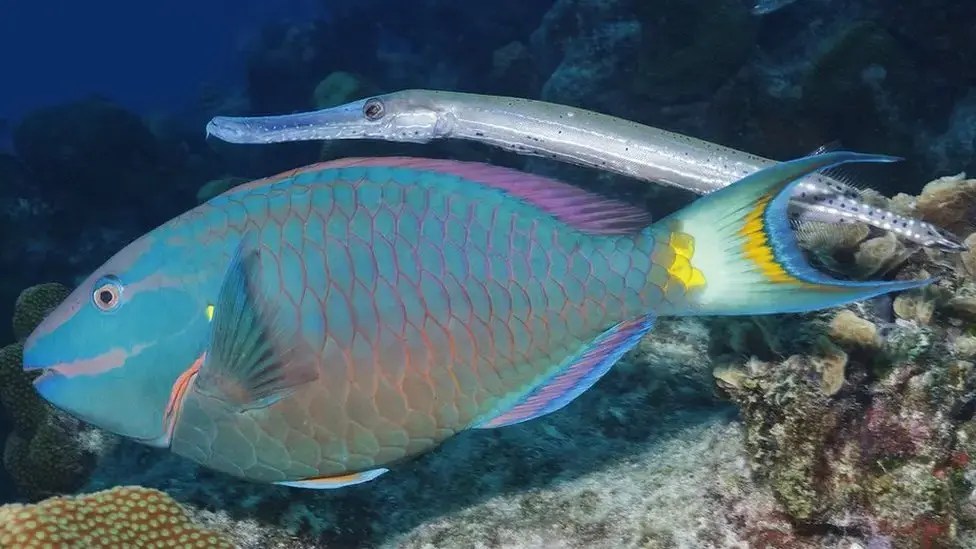
Trumpetfish (Aulostomus maculatus) often swim in close proximity to larger fish which has been suggested to enable them to remain concealed alongside the other animal as it approaches its prey. In 2020, Dr Sam Matchette and I went to Curaçao in the Caribbean Sea to experimentally test whether this ‘shadowing behaviour’ actually allows trumpetfish to approach their prey more closely without being detected. Following our finding that trumpetfish indeed gain closer access to prey via shadowing, Sam continued to study the behavioural ecology of trumpetfish, e.g., by investigating whether we see differences in the frequency and success rate of shadowing between the three colour morphs found within this species.
- Venables S.V., Drerup C., Powell S.B., Marshall N.J., Herbert-Read J.E. & How M.J. (2022) Polarization vision mitigates visual noise from flickering light underwater. Science Advances 8, eabq2770. Doi: 10.1126/sciadv.abq2770
- Drerup C., How. M.J. & Herbert-Read J.E. (2023) Visual noise from caustic flicker does not affect the hunting success of cuttlefish. Animal Behaviour 202, 59-72. Doi: 10.1016/j.anbehav.2023.06.002
- Drerup C., How. M.J. & Herbert-Read J.E. (In press) Dynamic visual noise has limited influence on the habitat selection and behavioural activity of crustaceans and cephalopods. In press in Ethology. Doi: 10.1111/ETH.13432
 Christian Drerup